
A Westminster junk removal crew's real take on rental move-outs: why the city's bulky-item program doesn't cut it for turnovers, what Colorado's e-waste law actually requires, and what a full cleanout really costs a landlord in lost rent.
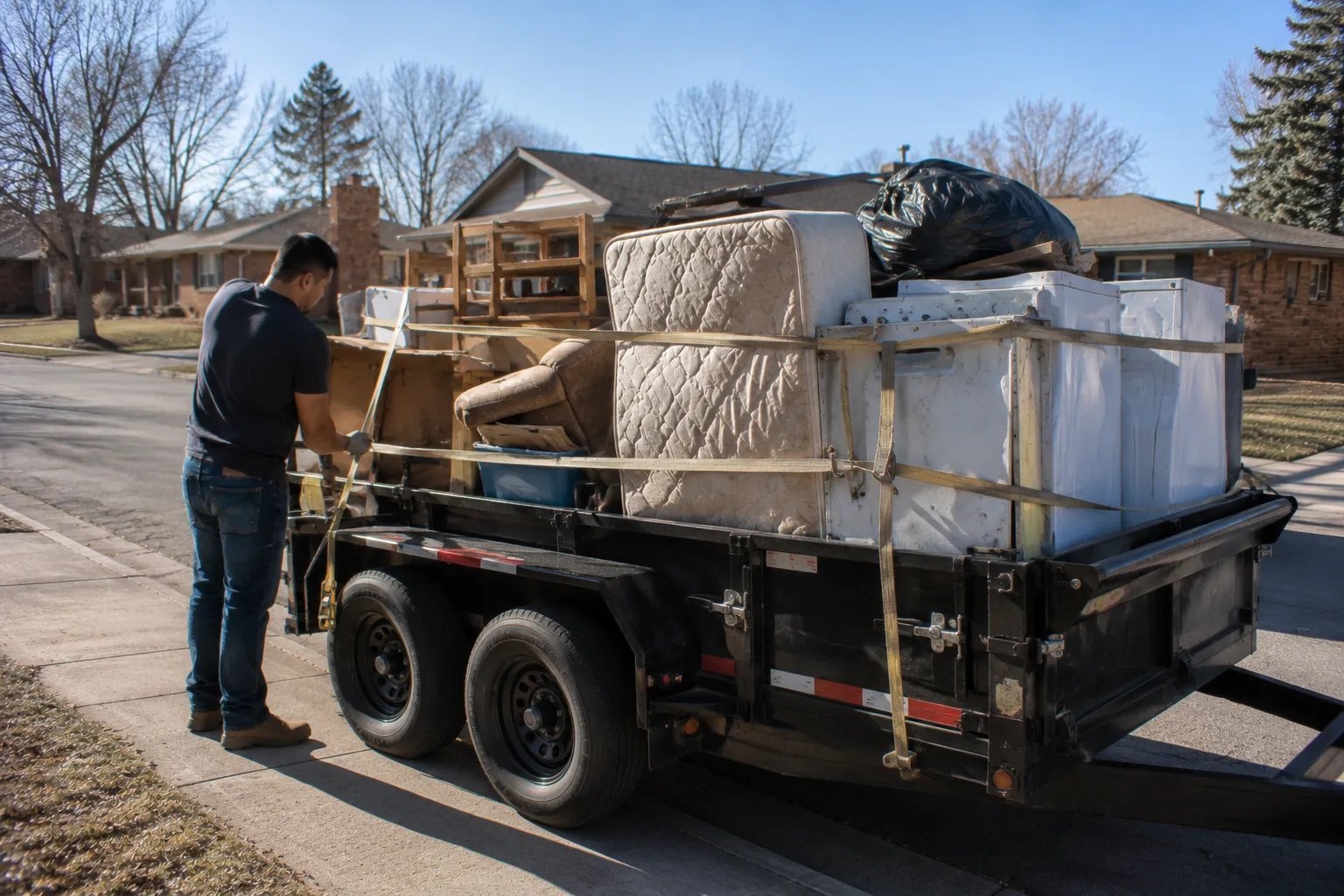
We've been picking up more move-out jobs this year than any year I can remember running this crew. Part of that is just the rental market right now, people bouncing out of the pricier Denver neighborhoods and landing in Westminster once a lease renewal jumps too much. But the reason it matters to a landlord or property manager isn't the market trend itself. It's that every one of those move-outs ends the same way: a unit full of furniture, boxes, and whatever a tenant couldn't be bothered to take with them, and somebody has to deal with it before the next renter can move in.
Westminster doesn't run its own trash pickup. You contract with a private hauler, and the city's own bulky-item option, the Large Item Pick-Up Program, was built for a homeowner clearing out a garage, not a property manager turning over a rental. It's thirty bucks to register, and whatever you're getting rid of has to fit in a pile no bigger than four feet by eight feet by four feet, set out curbside by 7 a.m. on your assigned day. Fine for an old couch and a busted water heater. Not fine for three rooms of furniture a tenant walked away from.
That 4x8x4 box sounds like plenty until you actually measure it against a real one-bedroom's worth of abandoned stuff. A mattress and box spring alone eats a third of that pile. Most full unit cleanouts we run are two or three times over what the program allows, which means registering multiple times across separate pickup weeks, or leaving items at the curb past the limit and hoping nobody cites you for it.
The program runs on a fixed citywide route. It doesn't run on your timeline. If you need a unit turned around in 48 hours because someone's moving in Friday, waiting for the next scheduled pickup week just isn't an option, and you have to register ahead of the pickup date anyway. So if a tenant hands back keys and you find a full cleanout job that day, you've already missed that week's window before a single box hits the curb.
Everything has to sit parallel to the sidewalk, not staged in the driveway, and it can't go out before the morning of pickup day. That's a minor annoyance for one house. For a multi-unit property clearing several vacancies at once, coordinating curb placement across a handful of doors on one specific morning, without blocking sidewalks or running into whatever extra rules an HOA has stacked on top, turns into its own small logistics job.
Move-out cleanouts almost always turn up a TV, a couple monitors, maybe an old printer somebody left behind in a home office setup. Colorado has had a specific rule about that stuff since 2013, and it's not optional.
Colorado's Electronic Recycling Jobs Act bans dumping e-waste in a landfill anywhere in the state. That covers computers, printers, TVs, DVD players, monitors, laptops, tablets, basically anything with a screen bigger than four inches. So that old TV or dead office printer sitting in a vacated unit can't go out with the regular pile, city program or not. Counties have to run at least two e-waste collection events a year or keep an ongoing recycling program running, but somebody still has to actually sort that stuff out before it hits a landfill truck. That's on the hauler, not the property manager.
If you're in Jefferson County, or you're technically in Arvada but sitting in Adams County, Rooney Road Recycling Center takes household hazardous waste and electronics. Adams County runs its own separate programs. Neither system is set up for a hauler to guess. Sorting e-waste before a landfill run is just a real, extra step in doing this legally, not something you can skip because you're in a hurry.
Not everything we pull out of a vacated unit is garbage, and treating it all the same way costs money you didn't need to spend. Furniture that's still in decent shape, small appliances that still work, boxed household goods, a lot of that can go to donation instead of the landfill. That matters for two reasons: it cuts what you're paying in tipping fees, and it's something you can point to if an owner or an outgoing tenant asks where their stuff actually ended up.
Furniture without real damage. Mattresses in decent shape. Appliances that still run and aren't ancient. Boxed goods. Those are the categories donation programs around here will actually take.
Stained or damaged mattresses, particle-board furniture that's swollen or coming apart, anything with mold or a strong smell. Donation centers turn that stuff away no matter how usable it looks to you. Sorting on-site before you haul, instead of finding out at the donation center door, is what separates a clean job from a wasted trip.
Landfill disposal gets priced by weight and volume around most of the Denver metro. Donation is free. Send a truckload of perfectly good furniture straight to the dump because nobody bothered sorting it, and you're paying a fee on something that could've gone out the door for nothing. Run a dozen turnovers a year and that adds up fast.
Sometimes a move-out overlaps with a renovation, especially if a landlord's using the empty unit to redo flooring or paint before the next tenant. Drywall, flooring, lumber, fixtures, none of that goes through the residential bulky-item program. It has to go to a landfill or transfer station that's actually rated to take it. Jefferson County has nine closed landfill sites; Adams County runs two active ones, Bennett City and Commerce City, plus eight closed ones. Knowing which facility takes what, and how much, isn't something most property managers track day to day, and honestly it doesn't need to be their job.
A property that straddles both counties, or a management company running buildings across the metro, can't assume one drop-off point works everywhere. Commerce City Landfill takes different material streams than a Jefferson County site, and a load that's fine at one gate gets turned away at the other over something as simple as mixing household junk with construction debris. Renovation timelines are tight enough without a truck getting sent home for showing up at the wrong facility.
A bigger renovation between tenants sometimes means a roll-off dumpster staged on-site instead of hauling load by load, and Westminster has its own rules about where that can sit, driveway, lot, or curb, separate from whatever the county requires at the landfill. An HOA can pile a third set of restrictions on top of that. None of it's impossible to work through. It's just one more reason it helps to have someone who's already dealt with the permitting and placement questions instead of figuring it out cold under a deadline.
Turnover on a Denver-area rental typically runs somewhere between $2,500 and $5,000 once you count cleaning, re-leasing, and everything else that goes into it. Every day a unit sits full of somebody's leftover furniture is a day of lost rent on top of that. A unit that takes an extra week to clear because it's stuck waiting on a scheduled city pickup instead of getting cleared on your own timeline is a direct hit to that number.
A typical Westminster one-bedroom renting around $1,400 to $1,600 a month works out to roughly $50 a day in lost rent once it's sitting empty and ready to show. A week waiting on a scheduled pickup, stacked on top of the cleaning and re-listing time you're already spending, adds a few hundred bucks to a turnover that was already costing $2,500 to $5,000. Run that across a dozen units a year and the gap between clearing a unit same-day versus waiting on the city's schedule stops being small money.
The Large Item Pick-Up Program was designed for a homeowner's occasional garage cleanout, not a business running a rotating schedule of vacant units. If you're handling multiple turnovers a month, you need something that runs on your timeline, not a fixed citywide route with a hard size cap. And the fee is per household registration, not per job, so running every single turnover through the $30 program stops making sense the moment you're clearing more than one or two units at a time.
Same-day or next-day, sized to whatever's actually in the unit instead of a fixed limit, with donation sorting and e-waste handling built into the job instead of left for the property manager to figure out. That's the difference between a unit sitting empty for a week and one that's ready to show tomorrow. A lot of the property managers we work with just set up a standing arrangement with a commercial junk removal service once they're doing more than a couple turnovers a year, so it's one call instead of scrambling every time a unit comes open.
Can I just use Westminster's Large Item Pick-Up Program for a rental turnover?
For a small leftover pile, sure. But the $30 registration only covers one pickup capped at 4 feet by 8 feet by 4 feet, on a fixed citywide schedule. A full unit's worth of furniture usually blows past that, and the schedule almost never lines up with a tight turnover deadline. Fine for one vacancy with a few items left behind. Not great for a multi-unit property or a fast turnaround.
Is it actually illegal to throw out an old TV or monitor in Colorado?
Yes. Colorado's Electronic Recycling Jobs Act has banned e-waste, TVs, monitors, computers, anything with a screen over four inches, from landfills statewide since 2013. It has to go through a recycling program or collection event instead.
What happens to furniture that gets left behind?
Depends on condition. Furniture and appliances in decent shape usually get donated instead of landfilled. Anything damaged, water-stained, or dealing with pests typically can't be donated and goes through regular disposal.
Do Jefferson and Adams County handle waste the same way?
No. Each county runs its own recycling and landfill setup. Jefferson County residents, and Arvada residents who are technically in Adams County, can use Rooney Road Recycling Center for hazardous waste and electronics. Adams County runs separate programs and its own active landfill sites.
Westminster's bulky-item program works fine if you're a homeowner clearing out a garage once in a while. It was never built for the pace rental turnovers move at now. Between the state's e-waste rules, two counties running two different disposal systems, and a city program capped at a size that doesn't fit a real unit's worth of stuff, a move-out cleanout has more pieces to it than it looks like from the outside. If you're handling more than the occasional turnover, you're usually better off with a junk removal company that sizes the job to what's actually there and works around your real move-in date instead of the city's pickup schedule.
Jacob Kingston started Westminster Junk Removal after years of hauling and cleanout work for other outfits around the north Denver metro, tired of jobs getting quoted by the hour instead of the actual load. Upfront, volume-based pricing became the model from day one: you know the number before anything gets carried out. As Westminster and nearby suburbs kept absorbing renters priced out of closer-in neighborhoods, the calls shifted too, more property turnovers, office and retail cleanouts alongside the usual garage and estate jobs. Jacob still runs crews on that same rule: quote it right, load it right, leave the place clean.
You must be logged in to post a comment.