From Taproom Stories to Social Media Craft Beer Marketing
From taproom moments to social media posts, breweries can use real stories to connect with beer love...

Customers now ask ChatGPT, Gemini and Perplexity which local business to call. This 20-minute self-check shows owners how to see if AI assistants recommend them, spot wrong details, find the sources AI relies on and know what to fix first.
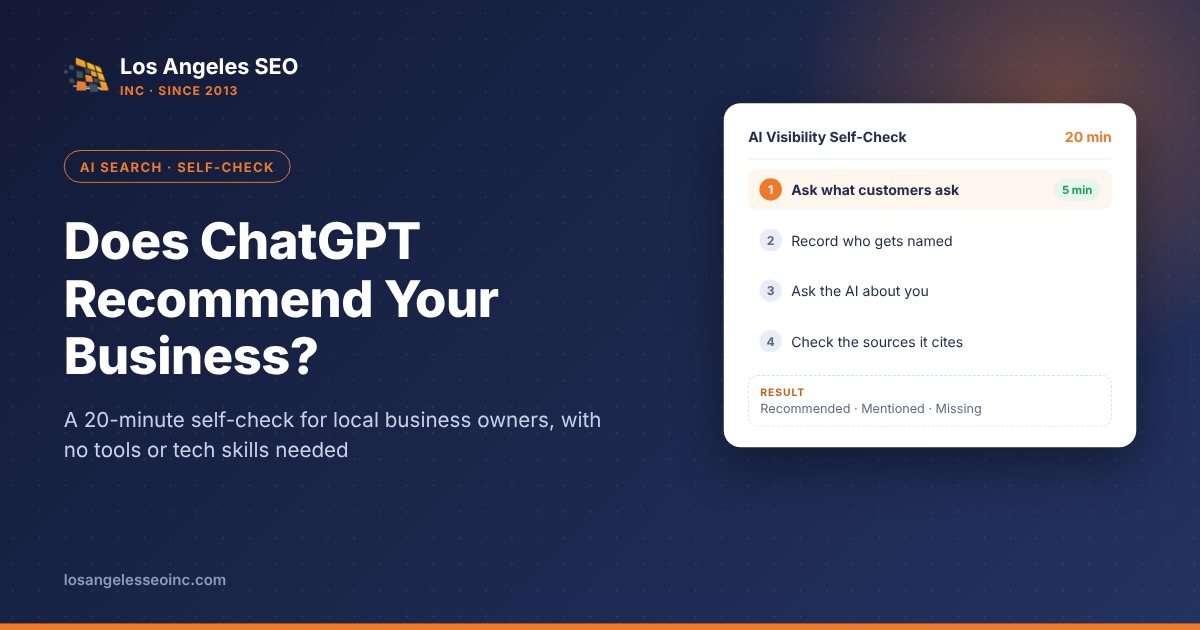
More customers now skip the search results page entirely. They open ChatGPT, Gemini, Perplexity or Microsoft Copilot and type something like "Who's the best plumber near Pasadena?" or "Which dentist in Glendale is good with nervous patients?" The assistant answers with a short list of names, often just three to five.
If your business is on that list, you have a real chance at the call. If it isn't, the customer may never know you exist.
The good news: you don't need special software or a marketing agency to find out where you stand. With a free account, a notepad and about 20 minutes, you can run a simple self-check today.
Write down five questions the way a customer would phrase them, not the way a marketer would. For example:
Run each question in each assistant. Don't rephrase to get a better result. The point is to see what a real customer sees.
For every answer, note:
You'll often see the answers differ from one assistant to the next. That's normal, and it's useful: it shows which sources each one relies on.
Now ask each assistant about your business by name:
Read the answers carefully. Common problems include:
Every one of these is a signal you can fix, because AI assistants repeat what they find published about you.
Perplexity and Copilot show their sources next to each answer, and ChatGPT shows links when it searches the web. Click through a few of them. You'll usually find a mix of:
Ask yourself two questions: Am I listed on these sources? And is my information there accurate and consistent? If a competitor keeps getting recommended, look at which sources the assistant cites for them. That shows you where you're missing.
Most businesses land in one of three groups.
Recommended, with accurate details. Protect your position. Keep reviews coming, keep your listings current and repeat this check every month.
Mentioned, but with wrong details. Find the source of the wrong information and correct it there. Fixing your own website alone often isn't enough if old directory listings still say something different.
Not mentioned at all. This usually means the AI can't find enough clear, consistent and trusted information about you. It isn't a judgment of your work. It's a gap in what's published, and gaps can be filled.
If you only have a few hours, work in this order:
[SASAN: add 3–5 sentences from your own experience here, with the client unnamed. For example: a business that was missing from AI answers because of an old phone number or name variation on directories, what you changed, and what you saw afterward. Use only what really happened; no numbers you can't back up.]
AI answers change with phrasing, location and time, so a single test is a snapshot, not a verdict. Save your five questions and rerun them monthly. The trend matters more than any one answer. And be wary of anyone who guarantees a top spot in ChatGPT: no one controls these answers. What you can control is how clear, accurate and consistent your business information is across the web.
Twenty minutes is a small investment for knowing whether the newest way customers search can find you. Run the check this week, write down what you find and fix the easiest gaps first.
About the author
Sasan Raeisi is the founder of Los Angeles SEO Inc, a Los Angeles digital marketing agency that has helped businesses with SEO, local SEO and AI search visibility since 2013. Business owners who want a second opinion on their results can request a free AI visibility check.
You must be logged in to post a comment.
Explore our curated selection of various articles in this category

From taproom moments to social media posts, breweries can use real stories to connect with beer love...
Running B2B email marketing without a dedicated team is possible with the right tools, strategy, aut...

Discover proven SEO strategies to rank #1 on search engine results and maintain your top spot. Learn...