Bradford Pears in Spring Hill: When to Keep Them and When to Take Them Down
Bradford pears are in almost every older yard in Spring Hill. They look good for about 15 years and...

Learn how to inspect trees before hurricane season, recognize warning signs, avoid harmful pruning practices, and determine when a professional tree assessment is needed.
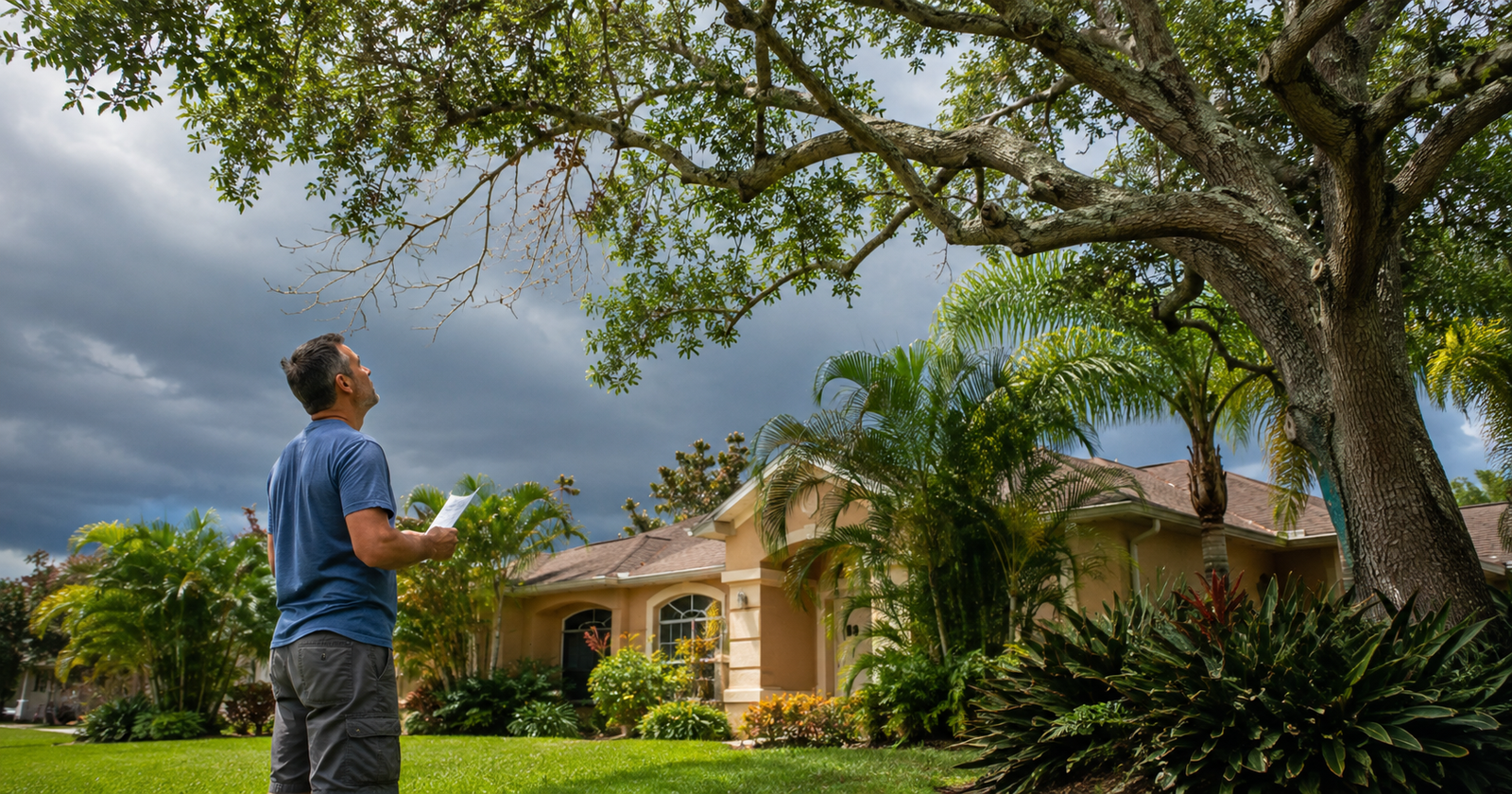
Hurricane preparation often begins with shutters, emergency supplies, and loose items on the patio. Trees deserve a place on that checklist too. High winds can snap large branches, topple poorly anchored trees, and turn dead wood into windborne debris.
The goal is not to make every tree “hurricane-proof.” No inspection or pruning method can guarantee that a tree will survive extreme weather. A useful pre-storm assessment identifies defects that may be corrected before strong winds arrive, while there is still time to make a careful decision.
This guide explains what Central Florida homeowners can inspect from the ground, which warning signs deserve professional attention, and which common attempts at storm preparation may weaken a tree instead of helping it.
Inspect trees well before a storm appears in the forecast. The Atlantic hurricane season begins June 1, but waiting until late May is not ideal if a property has large trees, neglected palms, or branches near buildings.
An early inspection gives you time to:
Do another brief inspection after unusually heavy rain, strong wind, nearby construction, or anything that disturbs the soil around a tree. Saturated soil and root damage can change a tree’s stability even when its canopy looks normal.
Walk completely around each large tree and view it from several distances. Do not climb the tree or stand beneath hanging limbs. Use binoculars if you need a closer look at the upper canopy.
The roots and surrounding soil help anchor a tree. Watch for:
A leaning tree is not automatically dangerous. Some trees grow at an angle for many years and remain stable. A new lean accompanied by disturbed soil, exposed roots, or cracking is more urgent.
The University of Florida’s IFAS Extension notes that construction damage near roots can reduce anchoring. Recent work on a driveway, sidewalk, irrigation line, or utility trench is therefore relevant when evaluating a tree.
From a safe distance, check the trunk for defects such as:
One visible symptom does not always reveal how much sound wood remains inside a trunk. Drilling, cutting, or striking a tree to “test” it is not a reliable do-it-yourself diagnostic method.
If a large tree could reach a home, road, play area, or parked vehicle, an assessment should consider both the likelihood of failure and what the tree could hit.
Branches and trunks of similar size that originate at the same point can form weak unions, particularly when bark is trapped between them. UF/IFAS identifies these co-dominant stems and bark inclusions as structures that may be more vulnerable in strong wind.
Also look for:
Dead twigs are common and do not necessarily mean an entire tree is failing. Large dead branches over a frequently used area, however, deserve timely attention.
It is tempting to assume that a shorter or nearly leafless tree will catch less wind. That reasoning leads some property owners to request topping—cutting major limbs back to stubs without regard for healthy branch structure.
Topping is not recommended storm preparation. The International Society of Arboriculture explains that topping can stress a tree, encourage weakly attached shoots, expose tissues to sun damage, and create openings that favor decay. The tree may look smaller immediately after the work while becoming structurally worse over time.
Useful pruning has a defined purpose. Depending on the tree, that might include removing dead or broken branches, correcting weak structure, or reducing the length of a specific overextended limb.
UF/IFAS hurricane research found that correctly pruned trees with open, well-distributed crowns survived high winds more often than unpruned trees in the study it cites. That finding supports preventive structural care—not indiscriminate thinning.
Removing too much live foliage at once can also stress a tree. A dense-looking canopy is not permission to strip out its interior branches. Every cut should have a reason.
Palms are not pruned like broadleaf trees. A so-called hurricane cut, which removes large numbers of green fronds, does not make a palm healthier or necessarily safer.
UF/IFAS recommends avoiding over-pruning palms before hurricanes and generally removing only dead or dying leaves. The International Society of Arboriculture also warns that over-pruned palms may grow more slowly and attract pests. Green fronds supply the palm with energy, and unnecessary removal can reduce its resources.
During a palm inspection, look for dead or hanging fronds, loose fruit or flower clusters where they could strike people, trunk damage, an abnormal lean, and problems around the terminal bud.
Climbing spikes should not be used on a palm that is being retained because the punctures permanently wound its trunk.
Small dead twigs that can be reached from the ground with a hand tool are different from overhead chainsaw work. Stop and seek qualified help when a tree involves:
Never prune near an overhead power line. Orlando Utilities Commission tells customers to report branches that hang, lean, or touch a line. It also warns people to keep themselves and their equipment at least 10 feet away. Contact the utility responsible for the line rather than attempting the work yourself.
For work safely away from electrical conductors, ask how the crew will protect people and property, whether debris removal is included, and what happens if the scope changes.
Homeowners comparing a tree service in Kissimmee should request a written estimate that identifies each tree, the purpose of the pruning, cleanup responsibilities, stump work if applicable, and the total price.
A low price is not useful if the proposed work damages the tree or leaves important details unresolved. Before accepting an estimate, examine the following areas.
Ask who will assess the tree and whether that person holds a current ISA Certified Arborist credential. Certification is not the same thing as a general business license, so verify it through the issuing organization.
Request current proof of liability insurance and workers’ compensation coverage appropriate to the job. Osceola County advises residents hiring someone to address a hazardous tree to make sure the company is licensed, bonded, and insured.
The estimate should describe what will be removed and why. Vague phrases such as “trim tree” or “hurricane cut” leave too much open to interpretation.
Better descriptions identify deadwood removal, clearance, structural pruning, or reduction of a particular branch.
Be cautious if a plan includes:
Confirm whether the price includes hauling away logs, branches, and palm debris.
If a tree is being removed, ask whether the stump will be cut low or ground. If stump grinding is included, determine how deep the grinding will go and who is responsible for locating irrigation pipes, electrical cables, or other underground utilities.
Rules can differ depending on whether an address lies within the City of Kissimmee or unincorporated Osceola County.
The City of Kissimmee advises property owners to confirm their jurisdiction because an address with a Kissimmee mailing designation may still fall outside city limits. Osceola County’s Development Review Services states that it issues tree-removal permits and enforces tree regulations.
Before removing a tree, confirm the current requirements with the appropriate local office. Also verify ownership when a trunk or major branches are close to a property line. Do not assume that an urgent-looking tree eliminates permit or notification requirements.
Wait until officials say outdoor conditions are safe. Treat every downed wire as energized, keep people and pets away, and report it to the utility.
Do not touch a branch, fence, vehicle, or puddle that may be in contact with a wire.
From a safe location, photograph the tree and surrounding damage before cleanup if doing so does not put you at risk. Look for:
Keep people and vehicles out of the potential fall area.
Storm damage can look dramatic without requiring complete removal. At the same time, a tree with limited visible damage may conceal a serious structural problem. Avoid making an irreversible decision based only on appearance. A qualified assessment can help distinguish between repairable damage and an unacceptable risk.
Use this short list during your next property inspection:
No. Correct pruning may improve structure and reduce specific defects, but wind, rainfall, soil saturation, tree condition, and storm intensity all affect the outcome. No reputable provider should promise that a tree is hurricane-proof.
No. A long-standing lean may be part of normal growth. A new lean, lifting roots, cracked soil, or a recent change after a storm is more concerning and should be assessed promptly—especially when the tree could strike people or property.
No. Topping can weaken a tree and stimulate poorly attached new growth. Proper reduction and structural pruning use selected cuts that preserve healthier branch relationships.
Generally, no. Florida guidance cautions against over-pruning palms and recommends removing dead or dying fronds rather than stripping away healthy green foliage.
Contact the utility responsible for the line. Do not attempt the work yourself, and do not bring ladders, pole saws, or other equipment close to energized conductors.
Good hurricane preparation is a year-round tree-care habit, not a rushed cutting job when a storm enters the forecast.
Inspect trees early, pay attention to changes, avoid practices that create future weakness, and use qualified help when work involves height, heavy branches, structural defects, or electricity. A careful decision made before storm season is usually safer for the homeowner, the crew, the property, and the tree.
You must be logged in to post a comment.
Explore our curated selection of various articles in this category
Bradford pears are in almost every older yard in Spring Hill. They look good for about 15 years and...
Shelby County has already seen two major ice storms in the last few years. Here's what homeowners in...