Preparing Bartlett, Tennessee Trees for Ice Storm Season
Shelby County has already seen two major ice storms in the last few years. Here's what homeowners in...

Bradford pears are in almost every older yard in Spring Hill. They look good for about 15 years and then they start splitting. Here's what we see on jobs, when one should come out, and what to plant instead.
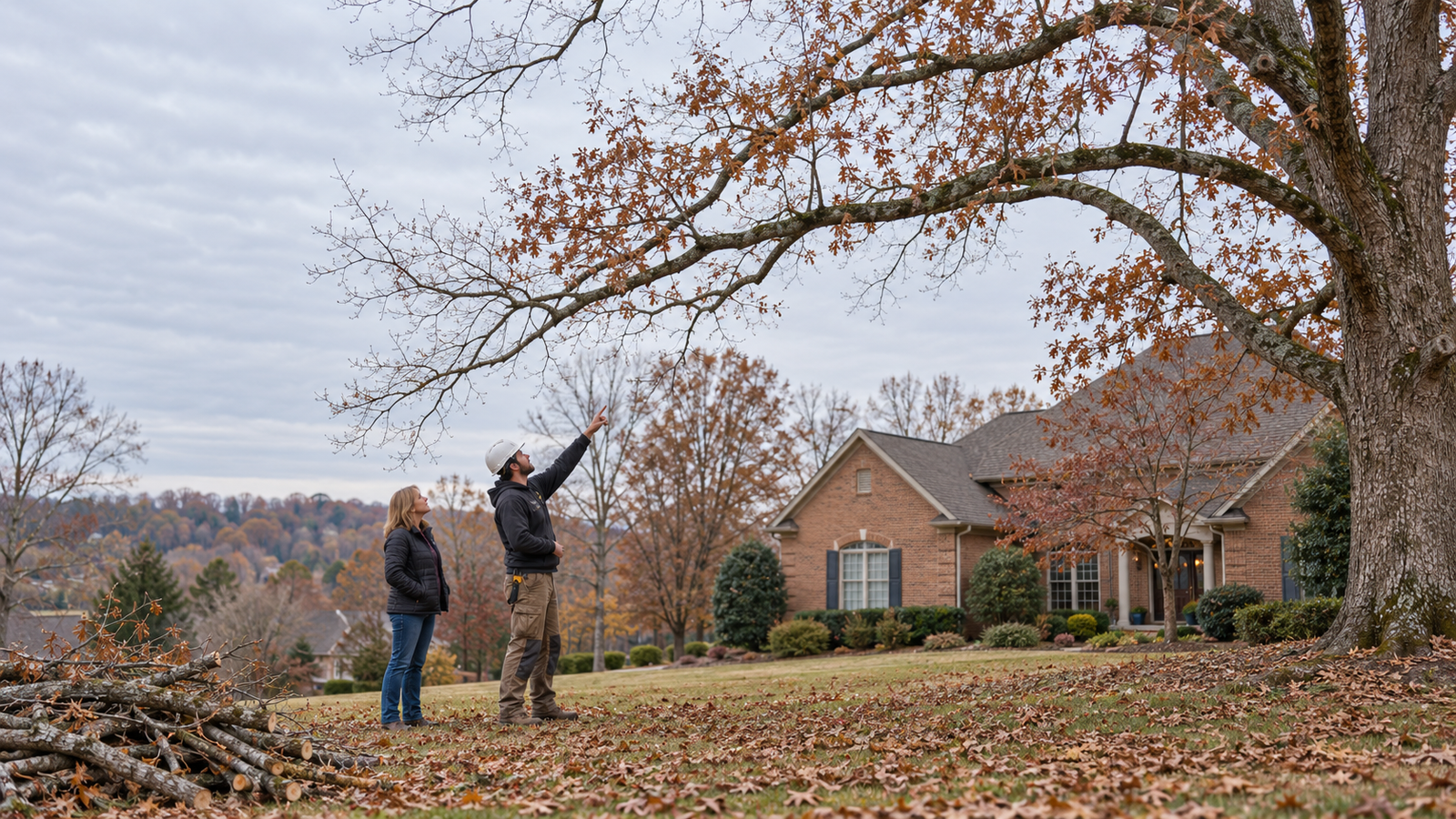
If you live in one of the older neighborhoods in Spring Hill, there's a good chance you've got a Bradford pear in the front yard. Builders planted them everywhere in the 90s and early 2000s. They grow fast, they're cheap, and they look great in the spring when they bloom white.
The problem is what happens after that. I get more calls about Bradford pears than just about any other tree, and most of the time somebody is calling because half of it is already on the ground.
A Bradford pear grows with a bunch of big limbs coming out of the trunk at the same spot. The angles are tight, like a V instead of a U. When the tree is young that's not a big deal. Once it gets to be 15 or 20 years old, those limbs are heavy, and there isn't enough wood holding them together.
Then we get a storm, or some ice, or even just a windy afternoon, and one of those limbs peels off. A lot of times it takes a big chunk of the trunk with it. Once a Bradford pear splits like that, there's really no fixing it. You can't glue it back together and cabling usually isn't worth the money on a tree like this.
The thing that surprises people is that the tree usually looks fine right up until it fails. Full of leaves, blooms every spring, no dead branches. Then one day it's laying across the driveway.
This part a lot of homeowners don't know. Bradford pears were supposed to be sterile, but they cross with other pear trees and now they make seeds. Birds eat the little fruit and drop the seeds everywhere. That's why you see white blooming trees all along the roads and empty lots around here in March. Those are mostly wild callery pears that came from yard trees like yours.
The wild ones grow thick and they've got long thorns. The University of Tennessee Extension lists callery pear as an established invasive threat in Tennessee, and the state's been pushing people to stop planting them. So even if yours never splits, it's still spreading.
Here's what I look at when I come out to a yard with a Bradford pear:
If none of that is going on and the tree is young, you can probably leave it for now. Just keep an eye on it.
Sometimes. On a younger Bradford pear we can thin it out and take some weight off the limbs, and that buys you some time. It doesn't change how the tree is built though. Those tight V angles are still there. You're just pushing the problem down the road a few years.
On an older tree that's already big, trimming usually isn't worth what you'd pay for it. You're going to end up taking it out anyway, so you pay twice. I'd rather tell somebody that up front than sell them a trim they don't need.
Most Bradford pears in town aren't huge, so it's usually not an all day job. If there's room to drop it, we can cut it down in a few big pieces. If it's close to the house or a fence, we take it down a piece at a time and lower the pieces with rope.
Then there's the stump. This is important with Bradford pears. If you just cut the tree and leave the stump, it'll send up a bunch of new shoots, sometimes within a few weeks. Mowing over them just makes it worse. You want the stump ground down below the dirt so the roots can't keep pushing up new growth.
Before anybody starts cutting, get a written price that says what's included. Does it include hauling everything off? Does it include grinding the stump? If a company won't come look at the tree and just gives you a number over the phone, I'd keep looking. A good tree service will walk the yard with you and tell you what they're going to do before they do it.
Once the pear is gone, people always ask what to put in its spot. You want something that doesn't split the same way. A few that do well around here:
Don't plant anything sold as a "flowering pear." Cleveland Select, Chanticleer, Aristocrat. Those are all callery pears with a different name. They have the same problems.
You don't have to plant right away either. Grind the stump this winter and plant in the spring when it's easier on the new tree.
Is my Bradford pear going to fall on my house?
I can't tell you that without seeing it. If it's over 15 years old, the limbs are big, and it's hanging over the roof, I'd at least have someone look at it before the next storm.
Does the city make me take it down?
Not that I know of for a tree in your own yard. Check with your HOA though, some of them have their own rules about what you can remove or plant.
Can I cut it down myself?
A small one out in the open, maybe, if you know how to run a saw safely. Anything near the house, a fence, or power lines, I wouldn't. They split weird and the limbs don't always fall where you think.
Why do I see so many of them along the road?
Those are mostly wild ones that grew from seeds birds spread out of yard trees. That's why the state wants people to stop planting them.
Bradford pears look good for a while and then they don't. If you've got an older one hanging over something important, it's worth getting it looked at before it splits on its own. Grind the stump when it comes out, and plant something native in its place.
Jason Rourke owns Spring Hill Tree Pros. They do tree trimming, tree removal, stump grinding, and storm cleanup around Spring Hill and the rest of Williamson and Maury County.
You must be logged in to post a comment.
Explore our curated selection of various articles in this category
Shelby County has already seen two major ice storms in the last few years. Here's what homeowners in...
Learn how to inspect trees before hurricane season, recognize warning signs, avoid harmful pruning p...